




How to play End User
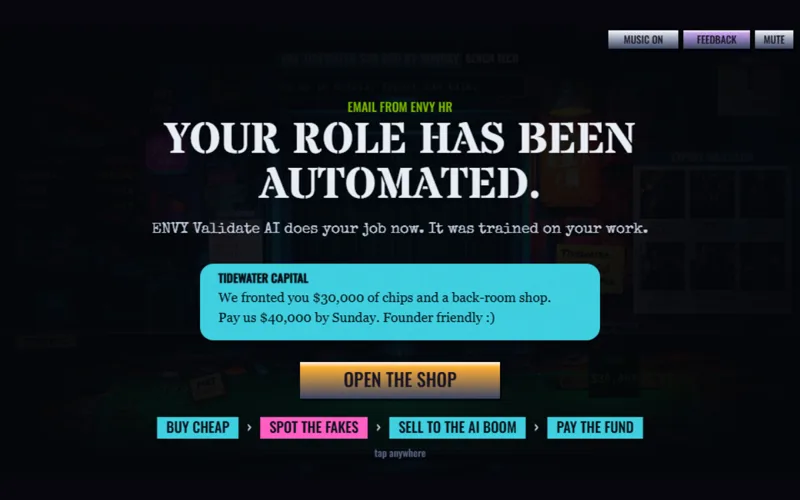
End User (stylized as END USER: AI Chip Smuggling Sim and searched as the End User game or End User browser sim) is a free satirical shopkeeper and hardware-inspection strategy game by Clouthier Simulation Labs. After ENVY Validate AI automates your corporate validation job—using a model trained on your own work—Tidewater Capital fronts you $30,000 in stock and a back-room repair shop above the Golden Arcade in Lantern Bay Free Port.
Your mission is to buy gray-market accelerators low, inspect every card on your anti-static mat to catch counterfeits (roughly one in four incoming parts is fake), sell genuine silicon into AI boom hype, and pay Tidewater $40,000 by Day 7 and $100,000 by Day 14. In the browser edition, both Today's Deal (a daily global challenge where every player inspects the exact same part) and the first three days of every run are completely free with zero sign-up.
Controls (Desktop & Mobile)
- Desktop (Mouse): Played entirely with point-and-click and drag actions on the workbench canvas. Click incoming GPUs and modules to flip them over and read serials and fuse codes, move parts onto diagnostic rigs, haggle offers with buyers at the window grille, and toggle audio (
MUSIC ON/MUTE) in the top-right corner. - Mobile & Tablet (Landscape Touch): Tap and drag directly on the workbench with your phone held sideways. In portrait mode on touch devices, the game prompts you to rotate your screen—tap Fullscreen below the player stage and turn your device to landscape for smooth touch inspection.
Workbench inspection tools & counterfeit tells
Before spending cash on diagnostics, always flip the hardware over to inspect its label for blurry re-etched fonts, mismatched VRAM chip counts (such as a "48 GB" sticker over 24 GB of packages), cut-down fuse codes, or cooked mining memory. Mei from Unit 9 records every tell that burns you into her notebook, and four shop upgrades unlock deeper verification:
| Diagnostic Tool | Shop Cost | Counterfeits & Defects Exposed |
|---|---|---|
| Scales | $1,500 (one-time) | Catches weighted bricks hidden inside server chassis and empty modules |
| X-ray Cabinet | $2,500 (one-time) | Sees beneath the heatspreader: re-marked dies, wrong VRAM counts, empty packages, fake LEDs |
| Thermal Camera | $3,000 (one-time) | Reveals mining-cooked memory, dead dies, and fake quantum parts heating in wrong spots |
| Benchmark Rig | $6,000 + $200 / run | Stress-tests live silicon to catch dead dies, export cut-downs, memory lies, and engineering samples |
Strategy tips: Heat, Leverage & market timing
- Prioritize the X-ray Cabinet early. At $2,500 with zero per-run fee, X-ray imaging catches re-marked lids and fake memory layouts that otherwise wipe out early working capital.
- Balance Heat and Leverage. Selling restricted chips, stolen serials, or tracked hardware raises Heat, bringing Agent Brooks of the Office of Controlled Exports to search your shop (only your floor safe stays hidden—always ask unfamiliar buyers who sent them). Meanwhile, answering the polite trade-delegation lady's supplier questions earns fast cash but builds Leverage (favors demanded at 3; total capture at 5).
- Watch the morning wall ticker. Model launches, leather-jacket keynotes, export bans, and crypto crashes swing prices daily—buy during panic dips and sell into AI startup mania.
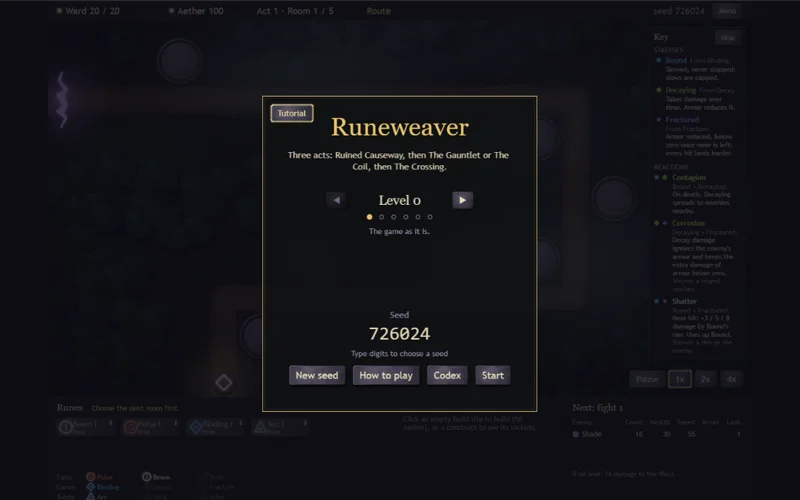
Want another deep browser strategy challenge? Craft three-rune tower synergies in Runeweaver or test your pricing instincts in Costcodle.