





How to play Runeweaver
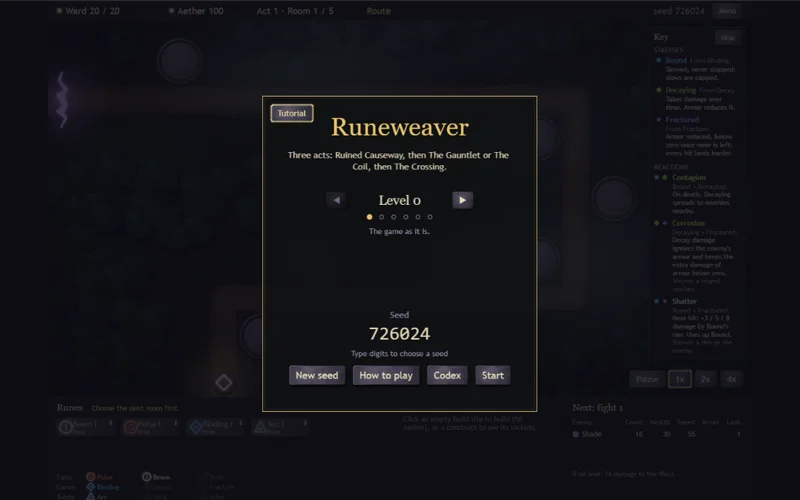
Runeweaver (sometimes searched as Rune Weaver or the Runeweaver tower defense game) is a free HTML5 roguelite strategy game by indie developer Jomsvikings. Instead of buying preset turrets from a static shop, you rebuild failing ancient wards by assembling custom constructs out of three distinct rune sockets:
- Cast runes define how a construct attacks—such as firing a focused Beam, radiating an area Pulse, or spinning an Orbit.
- Curse runes apply one of four status effects (Binding, Decay, Fracture, or Ember) to every enemy struck.
- Twist runes reshape attack behavior so shots Arc, Split, Echo, repeat, or linger on the lane.
Each run spans three acts and three bosses—starting in the Ruined Causeway, branching into The Gauntlet or The Coil, and culminating at The Crossing. After every battle, you draft a single rune from a small offer, navigating standard fights, Elites, Forges, Shrines, Treasures, and Unknown rooms while your Ward health carries over from act to act.
Controls (Desktop & Mobile)
- Desktop (Mouse): Played entirely with the mouse. Click an empty build site to spend Aether (50 Aether for a starter construct), drag and drop runes from your tray into a construct's sockets between waves, and toggle combat speed between Pause, 1×, 2×, and 4×. You can also type digits on the start screen to run a custom 6-digit seed.
- Mobile & Tablet (Touch): Tap build sites to place constructs and drag runes into sockets with your finger between fights. Because the battlefield, rune tray, and wave preview sit side-by-side in widescreen, tap Fullscreen beneath the player for comfortable touch accuracy.
Statuses & reactions quick reference
Runeweaver's deepest damage scaling comes from status reactions. Whenever two different Curses land on the same enemy—even from constructs on opposite ends of the map—a combo reaction triggers automatically:
| Combo / Mechanic | Rune Inputs | Verified Battlefield Effect |
|---|---|---|
| Contagion | Bound + Decaying | Slows the target; if it dies while afflicted, Decaying spreads to nearby enemies |
| Corrosion | Decaying + Fractured | Decay damage-over-time completely ignores enemy armor and benefits from sub-zero armor |
| Shatter | Bound + Fractured | Consumes Bound on the next hit to deal +3 / +5 / +8 bonus burst damage by tier |
| Rupture | Volatile (Ember) + Fractured | Detonates wider area explosions that ignore enemy armor |
| In-Game Codex | 4 Curses · 6 Reactions | Open Codex or toggle the right-hand Key panel anytime to check all six pairings |
Practical strategy tips for three-act clears
- Pair choke-point appliers with down-lane finishers. A fast-firing Pulse + Binding construct near the entrance primes whole packs so a Fracture or Decay construct further along the path triggers Shatter, Corrosion, or Contagion on contact.
- Read the wave preview before locking sockets. Check the bottom-right Next fight panel for enemy Count, Health, Speed, Armor, and Leak damage before starting a wave—swap in Fracture immediately whenever armored waves appear.
- Take early Elite rooms while Ward HP is healthy. Elite fights drop rare runes that define Act 2 and Act 3 synergies, whereas playing overly safe on normal fights can leave your DPS short against act bosses.
Looking for a faster reflex break between three-act strategy runs? Test your night-stage cornering in Pacenote Rally or unwind with a five-round historical puzzle in Chronophoto.